
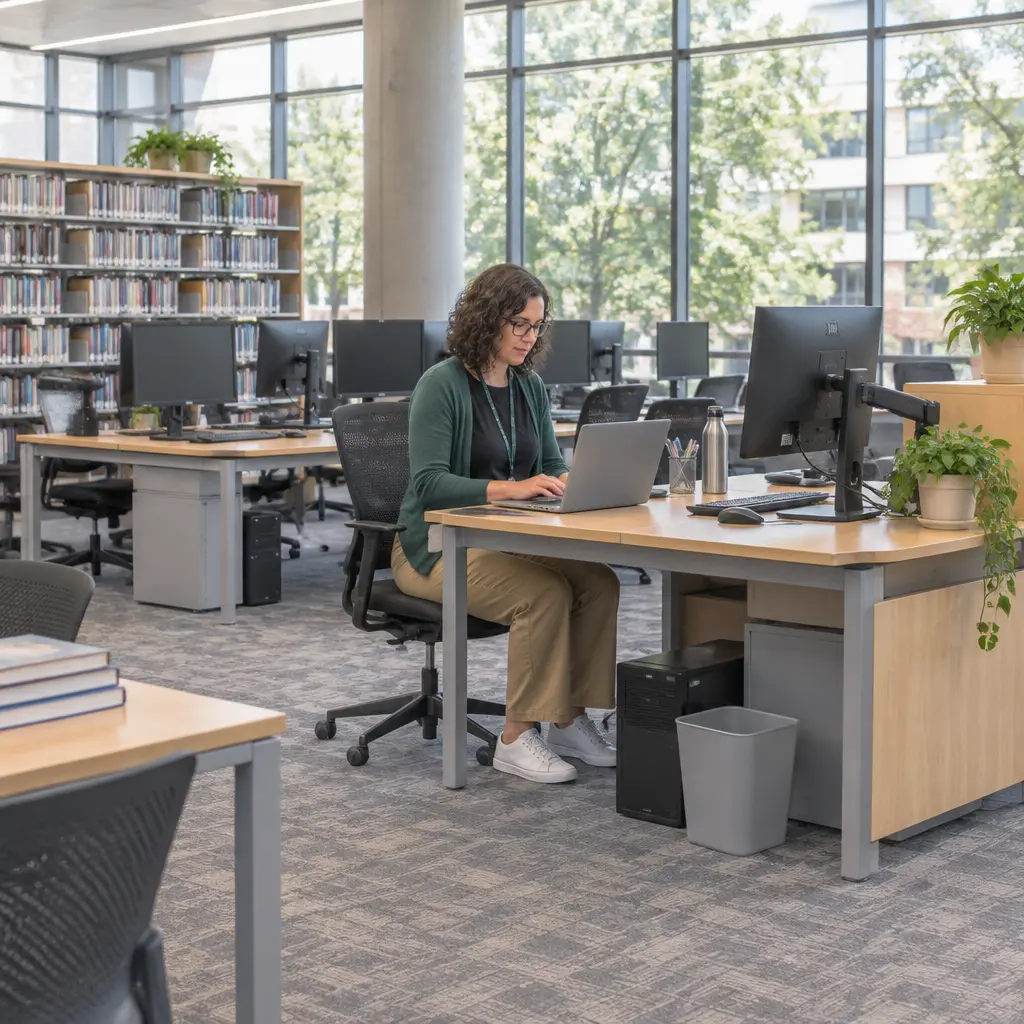
Remote and hybrid work models for library technology teams are ways of organizing staff, schedules, and services so technology work can be performed on-site, off-site, or through a planned combination of both. The right model depends on the work: software development, systems administration, digital scholarship, and user support may be suitable for remote or hybrid delivery, while equipment maintenance and some in-person services require library access. Evidence from broader workforce research shows that flexibility is a significant feature of contemporary work, but library-specific outcomes depend on service coverage, cybersecurity, collaboration, and equitable management. This article compares the main models, explains how to select and operate one, and considers measurement, risks, and practical examples.
Work Models Define Remote and Hybrid Library Technology Teams
A remote work model is an arrangement in which employees perform their duties away from a central workplace for some or all of their working time. A hybrid work model combines remote work with scheduled or role-based on-site work. The U.S. Office of Personnel Management describes telework as an arrangement in which an employee performs duties at an approved alternative worksite rather than at the agency worksite, subject to organizational policy and operational needs. For libraries, the essential distinction is not simply where staff sit, but how the team maintains reliable technology services while coordinating work across locations.
The scale of flexible work makes this a practical workforce issue. The U.S. Census Bureau reported that 13.8% of U.S. workers usually worked from home in 2023, up from 5.7% in 2019. Stanford economist Nicholas Bloom and coauthors, in a 2024 analysis of labor-force data, estimated that work from home accounted for about 28% of paid workdays among U.S. employees able to work remotely. These figures describe the wider labor market, not library employees specifically, but they show why libraries need deliberate policies rather than informal, individual arrangements.
Fully Remote Teams
A fully remote team works away from a shared library office as its normal arrangement. This model can suit roles whose outputs are primarily digital, such as application development, web content management, data analysis, documentation, and cloud-platform administration. It may also help libraries recruit specialized talent beyond their local commuting area. A remote designation does not remove the need for service coverage: teams still need clear support hours, escalation paths, secure equipment, and procedures for physical tasks that cannot be completed remotely.
Hybrid and Flexible-Schedule Teams
A hybrid team divides work between remote and on-site locations. Common variants include fixed anchor days, rotating office days, role-based attendance, and team-selected schedules. Hybrid arrangements are most useful when on-site time has a defined purpose, such as handling equipment, meeting users, coordinating a migration, or collaborating on work that benefits from shared space. Requiring attendance without a service or collaboration rationale can add commuting burden without improving outcomes.
On-Site and Distributed On-Site Teams
An on-site team works primarily from the library, while a distributed on-site team may be based across multiple branches, campuses, or institutions. These arrangements remain relevant for staff who maintain public computers, audiovisual systems, printers, networks, makerspaces, and specialized equipment. They can also provide a stable physical contact point for staff and patrons. A distributed team may use remote collaboration practices even when its members are on site, particularly when branches are geographically separated.
Role Suitability Shapes Remote and Hybrid Library Technology Teams
Role suitability means matching work location to the tasks, service obligations, and security requirements of a position rather than assigning flexibility by job title alone. The U.S. Office of Personnel Management emphasizes that telework eligibility depends on whether duties can be performed away from the official worksite and whether agency operations remain effective. For library technology teams, a single role can contain both remote-suitable work and tasks requiring physical presence, so managers should assess duties at the task level.
Remote-Suitable Digital Work
Digital work is generally more location-flexible when staff can access approved systems securely and deliver outcomes electronically. Examples include coding, database administration, catalog and discovery configuration, analytics, digital preservation planning, documentation, vendor coordination, and many forms of instructional technology support. The work still depends on dependable identity management, remote access, version control, ticketing, and backup procedures. A task being technically possible from home does not by itself establish that it is secure, supported, or appropriate under institutional policy.
Hybrid Tasks and Physical Service Dependencies
Hybrid tasks combine digital preparation with in-person execution. A systems librarian may configure a service remotely but visit a branch to test public workstations; a digital scholarship specialist may consult online but support a studio session in person. Libraries can map each task to its dependencies: equipment, physical collections, patron contact, local network access, or confidential materials. This makes scheduling more predictable and prevents remote work from becoming an unplanned transfer of on-site duties to whichever colleagues happen to be present.
Service Coverage and Equitable Work Allocation
Service coverage is the planned availability of staff to respond to users, incidents, and operational needs. A location-neutral schedule should identify who monitors help channels, who handles urgent incidents, and who can reach physical equipment. Managers should also review whether on-site assignments are distributed fairly. If some employees repeatedly absorb walk-up support or equipment work, the organization should rotate duties, adjust staffing, or recognize the additional workload in role expectations.
Management Practices Sustain Remote and Hybrid Library Technology Teams
Management practices are the policies, communication routines, tools, and evaluation methods that make a work arrangement function. The Society for Human Resource Management and public-sector telework guidance commonly stress clear expectations, suitable technology, and accountability for work outcomes. For library teams, these practices must also protect user privacy, maintain service continuity, and preserve access to institutional knowledge. Effective management replaces informal visibility with explicit goals, documentation, and dependable communication.
Outcome-Based Supervision
Outcome-based supervision evaluates work through agreed deliverables and service results rather than time spent visibly at a desk. Measures may include incident response and resolution, project milestones, system availability, documentation quality, accessibility improvements, and user feedback. The measures should reflect the nature of each role: counting tickets alone, for example, can reward volume over durable solutions. Regular one-to-ones and workload reviews help identify blockers without turning monitoring software into a substitute for trust.
Communication, Documentation, and Collaboration
Asynchronous communication allows colleagues in different locations or time zones to contribute without requiring simultaneous meetings. Written decision records, runbooks, project boards, and shared calendars are especially valuable when technical work involves handoffs or incident response. Meetings should have a defined purpose, accessible participation options, and a record of decisions. When a meeting includes remote and on-site participants, using shared digital materials and ensuring remote attendees can speak and see the discussion reduces the risk of creating a two-tier experience.
Technology, Security, and Privacy
Secure remote work depends on managed devices, multifactor authentication, timely patching, encrypted connections, least-privilege access, and clear procedures for lost equipment or suspected compromise. The National Institute of Standards and Technology’s telework guidance treats remote access as a security architecture concern, not merely a convenience feature. Library teams should apply institutional security standards to vendor access, administrator accounts, patron data, research information, and support records. Staff also need practical guidance on private workspaces, screen privacy, data storage, and avoiding unapproved personal devices.
Evaluation Measures the Results of Remote and Hybrid Library Technology Teams
Evaluation is the systematic review of service quality, employee experience, operational resilience, and cost. A credible assessment compares results with service expectations and, where possible, with the team’s own baseline before a policy change. There is no single universal productivity statistic for library technology work: uptime, user satisfaction, project delivery, and incident resolution describe different dimensions. Teams should use a balanced set of measures and interpret them in context rather than attributing every change to work location.
Service and Technical Performance Indicators
Useful indicators include system availability, time to acknowledge and resolve incidents, backlog age, service-desk satisfaction, project delivery against milestones, and the number of recurring issues eliminated through root-cause work. Libraries can display these measures in a simple dashboard or chart, separating service-level trends from staffing and project data. Targets should be realistic and co-developed with the people responsible for the service, because raw speed targets can encourage premature ticket closure or discourage complex work.
Employee Experience, Retention, and Inclusion
Employee experience includes workload, connection to colleagues, access to development, and perceived fairness. Gallup’s 2024 global workplace report found that 41% of employees worldwide experienced significant daily stress; the figure is not specific to remote workers or libraries, but it reinforces the need to monitor well-being rather than assuming flexibility automatically improves it. Libraries can use confidential pulse surveys, retention data, participation in training, and promotion patterns to identify whether remote and on-site employees have comparable access to mentoring and visibility.
Cost, Resilience, and Environmental Considerations
A work-model review can include facilities use, equipment and software costs, travel, recruitment reach, and continuity during disruptions. Remote access may support operations during severe weather or building closures, while distributed expertise can reduce dependence on a single location. Environmental effects are not automatic: fewer commutes may reduce travel emissions, but home energy use and duplicated equipment also matter. Libraries should treat these as locally measurable considerations rather than making unsupported claims about guaranteed savings.
Risks Require Deliberate Design for Remote and Hybrid Library Technology Teams
Risks are foreseeable threats to service quality, staff well-being, security, or fairness. They include isolation, communication gaps, unequal access to advancement, blurred work boundaries, cybersecurity exposure, and weak coverage for physical services. These are management and design challenges, not proof that one location model is inherently superior. A useful policy identifies the risk, assigns an owner, and establishes a mitigation that can be reviewed.
Isolation and Unequal Visibility
Remote employees can miss informal learning and spontaneous problem-solving, while on-site employees may receive more immediate recognition simply because they are visible. Teams can reduce this gap by documenting decisions, rotating meeting facilitation, making training accessible remotely, and using transparent criteria for assignments and promotion. Intentional mentoring and periodic team sessions can support connection without requiring unnecessary office attendance.
Workload Boundaries and Burnout
When work is accessible everywhere, employees may feel pressure to remain available beyond agreed hours. Teams should define response-time expectations, emergency on-call duties, quiet hours, and backup coverage. Managers can review overtime, after-hours messages, leave use, and workload distribution as early indicators of strain. Flexibility should give employees more control over where and when appropriate work occurs, not extend the workday indefinitely.
Security and Continuity Failures
A remote-work plan can fail if secure access is unreliable, devices are unsupported, or only one person knows how to restore a critical system. Libraries should test incident and disaster-recovery procedures, maintain current documentation, and ensure that privileged access is auditable. Hybrid schedules also need a clear physical-response plan for outages affecting servers, networks, public computers, or specialized spaces.
Implementation Converts Work-Model Choices into Library Practice
Implementation is the staged process of moving from a policy decision to a stable operating arrangement. Rather than selecting a model based only on preference or a broad workplace trend, a library can pilot options with clear service expectations, collect evidence, and revise the design. The approach should involve technology staff, library leadership, human resources, information security, and representatives of the users who depend on the services.
A Practical Pilot and Review Cycle
- Inventory team tasks, service hours, physical dependencies, security needs, and critical skills.
- Define role-level eligibility and the operational reasons for required on-site work.
- Set service standards, communication norms, equipment responsibilities, and escalation procedures.
- Run a time-limited pilot with baseline measures for service quality, workload, employee experience, and cost.
- Review results with staff and stakeholders, adjust inequities or coverage gaps, and document the final policy.
Illustrative Library Applications
A university library might allow its application developers and digital collections staff to work remotely most days while scheduling periodic on-site sessions for equipment testing, digitization, and stakeholder workshops. A public library system could use a hybrid central technology team, with designated branch visits for network and device maintenance and remote coverage for software support. These examples illustrate task-based design; each institution must adapt its arrangement to its staffing, collective agreements, privacy obligations, public-service hours, and infrastructure.
Conclusion: Remote and Hybrid Library Technology Teams Need Purposeful Policies
Remote and hybrid work models are most effective when they align location with task requirements, preserve dependable service coverage, and give employees clear expectations. Role suitability distinguishes digital work from tasks requiring physical access; management practices provide security, communication, and outcome-based supervision; evaluation checks service results and employee experience; and risk controls address fairness, well-being, and continuity. Broader workforce data confirms that remote work is now a substantial part of working life, but libraries should rely on local evidence when choosing their own model.
Library leaders can begin with a task inventory and a limited pilot, then review measurable outcomes with staff and users. Further reading should include institutional telework policies, NIST remote-access guidance, and workforce data from the U.S. Census Bureau and the Bureau of Labor Statistics. The goal is not to maximize remote days or office attendance, but to build a resilient technology team that supports equitable, reliable library services.
Sources: U.S. Census Bureau, “2023 American Community Survey: Commuting Characteristics by Sex,” https://www.census.gov/newsroom/press-releases/2024/acs-commuting-characteristics.html; Nicholas Bloom, Ruobing Han, and James Liang, “Hybrid working from home improves retention without damaging performance,” Nature, 2024, https://www.nature.com/articles/s41586-024-07500-2; U.S. Office of Personnel Management, “Telework,” https://www.opm.gov/telework/; National Institute of Standards and Technology, “Guide to Enterprise Telework, Remote Access, and Bring Your Own Device (BYOD) Security,” Special Publication 800-46 Revision 2, https://csrc.nist.gov/pubs/sp/800/46/r2/final; Gallup, “State of the Global Workplace: 2024 Report,” https://www.gallup.com/workplace/349484/state-of-the-global-workplace.aspx; Society for Human Resource Management, “Managing Remote and Hybrid Employees,” https://www.shrm.org/; U.S. Bureau of Labor Statistics, “American Time Use Survey,” https://www.bls.gov/tus/.