
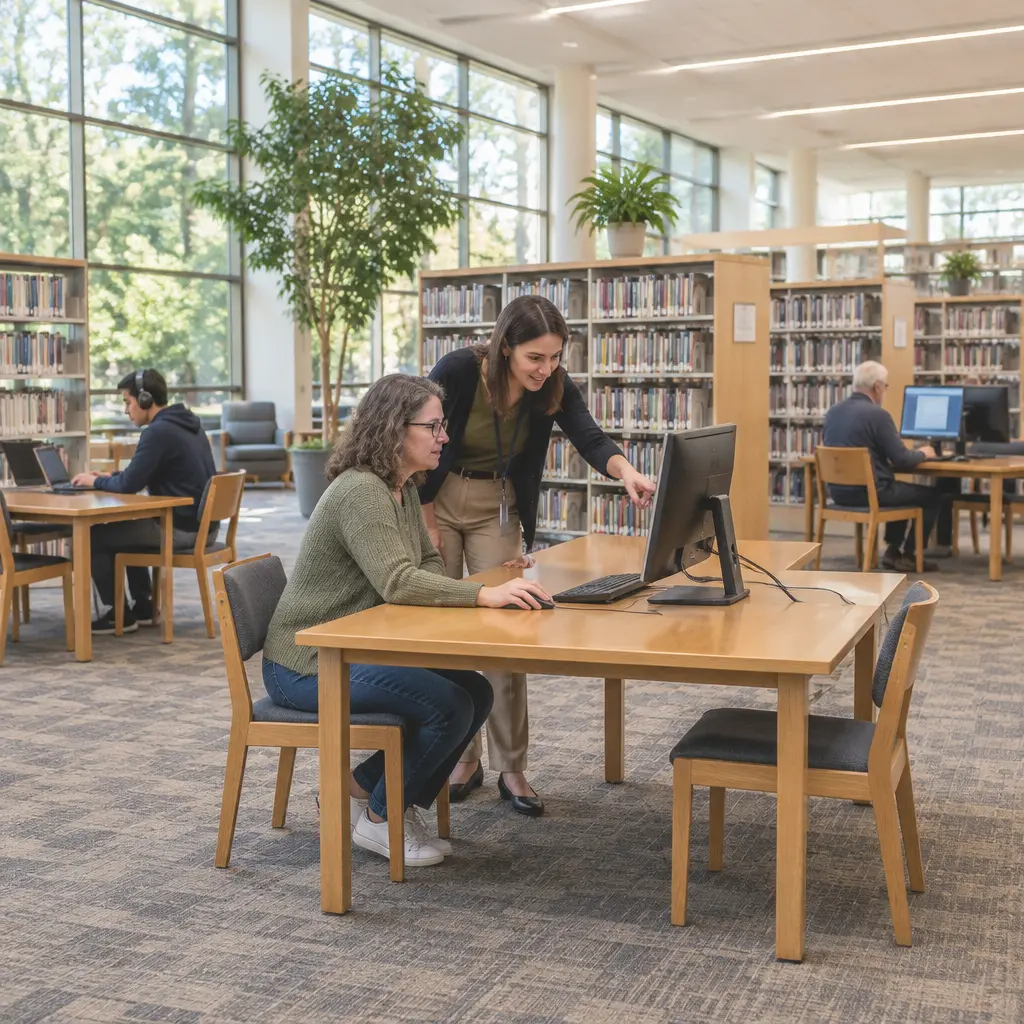
Libraries are public and academic institutions that organize knowledge and provide people with access to information, learning, and community resources. Technology is changing how they deliver those services: digital collections and online discovery tools broaden access, artificial intelligence and data systems reshape research support, and makerspaces and connected devices add hands-on learning. The change is substantial: the Institute of Museum and Library Services reported that U.S. public libraries recorded more than 1.1 billion visits in fiscal year 2019, while Pew Research Center found that 23% of U.S. adults had used a library website or app in the previous year in its 2021 survey. These trends make the central issue not whether libraries will use technology, but how they can use it equitably, securely, and in ways that strengthen human expertise.
Digital access is expanding the library’s core service
Library technology means the digital systems, devices, networks, and services libraries use to acquire, organize, preserve, and provide access to information. The American Library Association describes digital inclusion as the ability to access and use information and communication technologies; that idea helps explain why a library’s technology role extends beyond owning computers. It includes reliable connectivity, accessible interfaces, digital skills, and assistance from knowledgeable staff.
The main forms of digital access include electronic collections, online catalogs, remote services, and public computing. Together, these tools let patrons search and use resources beyond the physical building, while raising important questions about affordability, accessibility, privacy, and long-term preservation.
E-books, databases, and digital collections
Digital collections are books, journals, newspapers, images, recordings, and other materials made available in electronic form. Libraries license many commercial e-books and databases, while also digitizing local history, rare materials, and public-domain works. Patrons can often consult these resources remotely using a library card, which is particularly valuable for people who live far from a branch, have mobility limitations, or need materials outside regular opening hours.
The Association of College and Research Libraries’ 2023 report on academic libraries documents the continuing importance of digital collections and electronic resource spending in higher education. But digital access is not automatically permanent or universal: licensed content may be subject to limits on simultaneous users, lending periods, or renewal, and vendors can change terms. Preservation programs such as the Digital Public Library of America’s partnerships help make cultural materials discoverable across institutions, while libraries still need to plan for file formats, metadata, rights, and durable storage.
Online catalogs and discovery systems
A discovery system is a search interface that helps people locate books, articles, media, and other library resources across catalogs and databases. Modern systems commonly support keyword search, filters, digital checkouts, account management, and recommendations. They can reduce the friction of finding material, but results depend on accurate catalog records and well-designed search features. Librarians remain essential for research consultations, source evaluation, and helping users refine a question when a search returns too much—or too little—information.
Public Wi-Fi, computers, and digital inclusion
Public computing and internet access are technology services that help people participate in education, work, government, and everyday life. The American Library Association’s 2023 Public Library Technology Survey found that public libraries continue to provide public internet access, computers, and technology-related assistance as core services. During the COVID-19 pandemic, libraries also used outdoor Wi-Fi, loaned devices, and expanded online programming to reach patrons when buildings were closed or access was limited.
These services matter because home broadband and suitable devices are not equally available. Libraries can help patrons complete job applications, access telehealth, use government services, and build digital skills. The bridge from access to effective use leads to another major shift: technology is also changing how libraries support research and learning.
Research technology is changing how libraries organize knowledge
Research technology consists of the digital tools and methods that support discovering, evaluating, managing, and analyzing information. Libraries use metadata systems, linked data, research repositories, and analytics to connect people with resources. These tools can make collections easier to search and reuse, but their value depends on transparent standards and human oversight.
Metadata, linked data, and improved discovery
Metadata is structured information describing an item, such as its title, author, subject, date, format, and rights. Libraries use it to organize collections and make materials findable across systems. Linked data extends this approach by connecting records to shared identifiers and related datasets, allowing a person, place, or subject to be represented consistently across institutions. The Library of Congress has developed linked-data initiatives to improve how cultural and bibliographic resources are identified and connected.
Better metadata can make specialized and historical materials easier to discover, including resources that do not use current terminology. Yet cataloging choices can also reproduce bias or obscure communities when descriptive language is outdated or imposed without consultation. Libraries increasingly review subject headings and descriptions with attention to cultural context and community input.
Institutional repositories and open scholarship
An institutional repository is a digital platform that collects, preserves, and shares an organization’s scholarly and creative output. Universities use repositories for articles, theses, datasets, and reports, supporting long-term access and compliance with funder requirements. The Registry of Open Access Repositories tracks repositories worldwide, reflecting how open scholarship has become an established part of research infrastructure.
Libraries often guide researchers through copyright, data management, persistent identifiers, and open-access publishing. These services make scholarship more discoverable while helping authors understand that free-to-read access does not eliminate the need to protect privacy, document methods, or preserve data responsibly.
Artificial intelligence and research assistance
Artificial intelligence in libraries includes automated tools for search, transcription, translation, recommendation, classification, and research assistance. AI can speed up repetitive work and help users explore large collections, but generated answers may be inaccurate, incomplete, or difficult to verify. The International Federation of Library Associations and Institutions emphasizes the importance of information literacy and critical evaluation in an environment shaped by algorithmic systems.
Libraries are responding by teaching patrons how to check AI-generated claims against reliable sources, understand citation and copyright issues, and protect sensitive information. The goal is not to replace librarians with automated systems; it is to use tools selectively while preserving professional judgment, clear accountability, and human support.
Emerging technologies are making libraries places to create
Emerging library technologies are tools that enable patrons to make, test, or share things as well as consume information. Makerspaces, assistive technologies, digital fabrication, and immersive media broaden the library’s educational role. Their success depends on more than equipment: programs need instruction, safety procedures, accessible design, and ongoing funding.
Makerspaces and digital fabrication
A makerspace is a shared area where people can learn through practical projects using tools such as 3D printers, laser cutters, sewing machines, electronics kits, or audio and video equipment. Libraries use these spaces to support creativity, STEM learning, entrepreneurship, and intergenerational collaboration. The Institute of Museum and Library Services has documented how libraries and museums use community-based learning and technology to connect people with hands-on experiences.
A makerspace can also help patrons develop transferable skills, from prototyping to problem-solving. However, equipment can be costly to maintain, and access may be limited without staff training or scheduled instruction. A successful program aligns its tools with local interests rather than treating technology acquisition as an end in itself.
Assistive and accessible technologies
Assistive technology includes devices and software that help people with disabilities access information and participate in library services. Examples include screen readers, magnification tools, captioning, adaptive keyboards, hearing loops, and accessible e-book formats. The World Wide Web Consortium’s Web Content Accessibility Guidelines provide widely used standards for making digital content more perceivable, operable, understandable, and robust.
Accessibility is most effective when built into procurement and service design, rather than added after a problem is reported. Libraries can test websites and devices with disabled users, provide staff training, and offer multiple ways to access the same material. These practices benefit many patrons, including people using mobile devices, reading in a second language, or navigating a temporary injury.
Virtual reality and immersive learning
Virtual reality and augmented reality are immersive technologies that place digital content within a simulated or physical environment. Some libraries use them for educational demonstrations, virtual field trips, creative projects, or professional training. Such applications can make abstract topics easier to explore, but headsets and software may be expensive, require supervision, and exclude patrons who experience motion sickness or cannot use the equipment comfortably.
Immersive technology is therefore best treated as one learning option among several, with alternatives available. As libraries add new tools, they must also manage the risks associated with collecting data and connecting public users to online services.
Privacy, cybersecurity, and equity shape responsible adoption
Responsible library technology is the adoption of digital tools in ways that protect users, sustain services, and distribute benefits fairly. Libraries hold a distinctive position because people may seek information about health, employment, politics, or personal challenges without wanting that activity exposed. The American Library Association’s Library Bill of Rights and privacy guidance support the principle that intellectual freedom depends on protecting reader confidentiality.
Patron privacy and data minimization
Patron privacy means limiting unnecessary collection, retention, and disclosure of information about library use. Digital services may record searches, account details, device identifiers, or borrowing activity. Libraries can reduce exposure by collecting only what a service needs, setting retention limits, reviewing vendor contracts, and explaining privacy practices in plain language. The National Institute of Standards and Technology’s Privacy Framework offers organizations a structured way to identify and manage privacy risks.
Privacy choices also influence technology design. A convenient personalization feature may require tracking, for example, so patrons should be able to understand what data is used and whether they can opt out. Clear policies help preserve trust without preventing useful digital services.
Cybersecurity and continuity planning
Cybersecurity is the protection of systems, networks, and information from unauthorized access, disruption, or damage. Libraries depend on networks for circulation, catalog access, staff operations, and public computing, making system outages a direct service issue. The Cybersecurity and Infrastructure Security Agency recommends practices such as multifactor authentication, software updates, backups, staff awareness, and incident-response planning.
Libraries can strengthen resilience by identifying critical systems, restricting access according to job needs, maintaining recoverable backups, and preparing alternative ways to serve patrons during disruptions. Security planning should account for limited budgets and staffing, particularly in small and rural institutions.
The digital divide and fair access
The digital divide is the gap between people who can effectively access and use digital technologies and those who cannot. The Federal Communications Commission’s broadband mapping work documents differences in fixed and mobile internet availability, while the National Telecommunications and Information Administration has highlighted disparities in adoption and device access. A connection alone is not enough if it is slow, unaffordable, inaccessible, or unavailable in a person’s preferred language.
Libraries address these barriers through public Wi-Fi, device lending, technology coaching, accessible resources, and partnerships with schools and community organizations. The broader lesson is that technology expands library services most effectively when investment includes people, training, and equitable access—not only hardware. Libraries planning their next steps can use the checklist below as a practical starting point.
- Ask patrons and community partners which barriers and services matter most.
- Assess accessibility, privacy, security, maintenance costs, and staff capacity before purchasing tools.
- Provide instruction and human assistance alongside self-service technology.
- Review usage and feedback regularly, and revise services when they do not reach intended communities.
Conclusion: technology is reshaping access, research, and community learning
Technology is changing libraries through digital access, smarter discovery, research infrastructure, creative learning spaces, and new forms of public service. E-books and online catalogs make collections available in more places; metadata, repositories, and AI tools alter how information is found and assessed; makerspaces and assistive technologies support participation and creation. At the same time, privacy, cybersecurity, accessibility, and the digital divide determine who benefits and at what cost.
Libraries’ broader role remains rooted in connecting people with trustworthy information and learning opportunities. Patrons can help shape that future by asking their local library about digital collections, device lending, technology training, accessibility services, and privacy policies. Library leaders can build on that input by evaluating technology not simply for novelty, but for measurable public value, inclusion, and resilience.
Sources: Institute of Museum and Library Services, Public Libraries Survey, https://www.imls.gov/research-evaluation/data-collection/public-libraries-survey; Pew Research Center, Libraries and Learning, https://www.pewresearch.org/internet/2021/09/09/libraries-and-learning/; American Library Association, Digital Inclusion, https://www.ala.org/advocacy/digitalinclusion; Association of College and Research Libraries, Academic Library Trends and Statistics, https://www.ala.org/acrl/publications/academic-library-trends; Digital Public Library of America, About DPLA, https://dp.la/about; American Library Association, Public Library Technology Survey, https://www.ala.org/tools/research/libraries-respond/public-library-technology-survey; Library of Congress, Linked Data Service, https://www.loc.gov/bibframe/; Registry of Open Access Repositories, About ROAR, https://roar.eprints.org/; International Federation of Library Associations and Institutions, IFLA Statement on Libraries and Artificial Intelligence, https://www.ifla.org/publications/ifla-statement-on-libraries-and-artificial-intelligence/; Institute of Museum and Library Services, Learning Labs, https://www.imls.gov/issues/national-initiatives/learning-labs; World Wide Web Consortium, Web Content Accessibility Guidelines (WCAG) 2.2, https://www.w3.org/TR/WCAG22/; American Library Association, Privacy and Confidentiality, https://www.ala.org/advocacy/privacy; National Institute of Standards and Technology, NIST Privacy Framework, https://www.nist.gov/privacy-framework; Cybersecurity and Infrastructure Security Agency, Cybersecurity Best Practices, https://www.cisa.gov/topics/cyber-threats-and-advisories/best-practices; Federal Communications Commission, National Broadband Map, https://broadbandmap.fcc.gov/; National Telecommunications and Information Administration, Digital Nation Data Explorer, https://www.ntia.gov/data/digital-nation-data-explorer.